
Choosing to upgrade your factory ERP software is a massive financial decision. When manufacturing leaders invest in a new platform, they expect Microsoft Dynamics 365 ERP systems to meet their requirements for handling complex production lines and global supply chains. Buying the right software is only half the battle. The real risk lies in who you hire to set it up. A generic software vendor might know how to configure accounting rules, but that does not mean they understand shop floor operations, machine routing, or raw material planning. You need an implementation partner who actually understands manufacturing workflows.
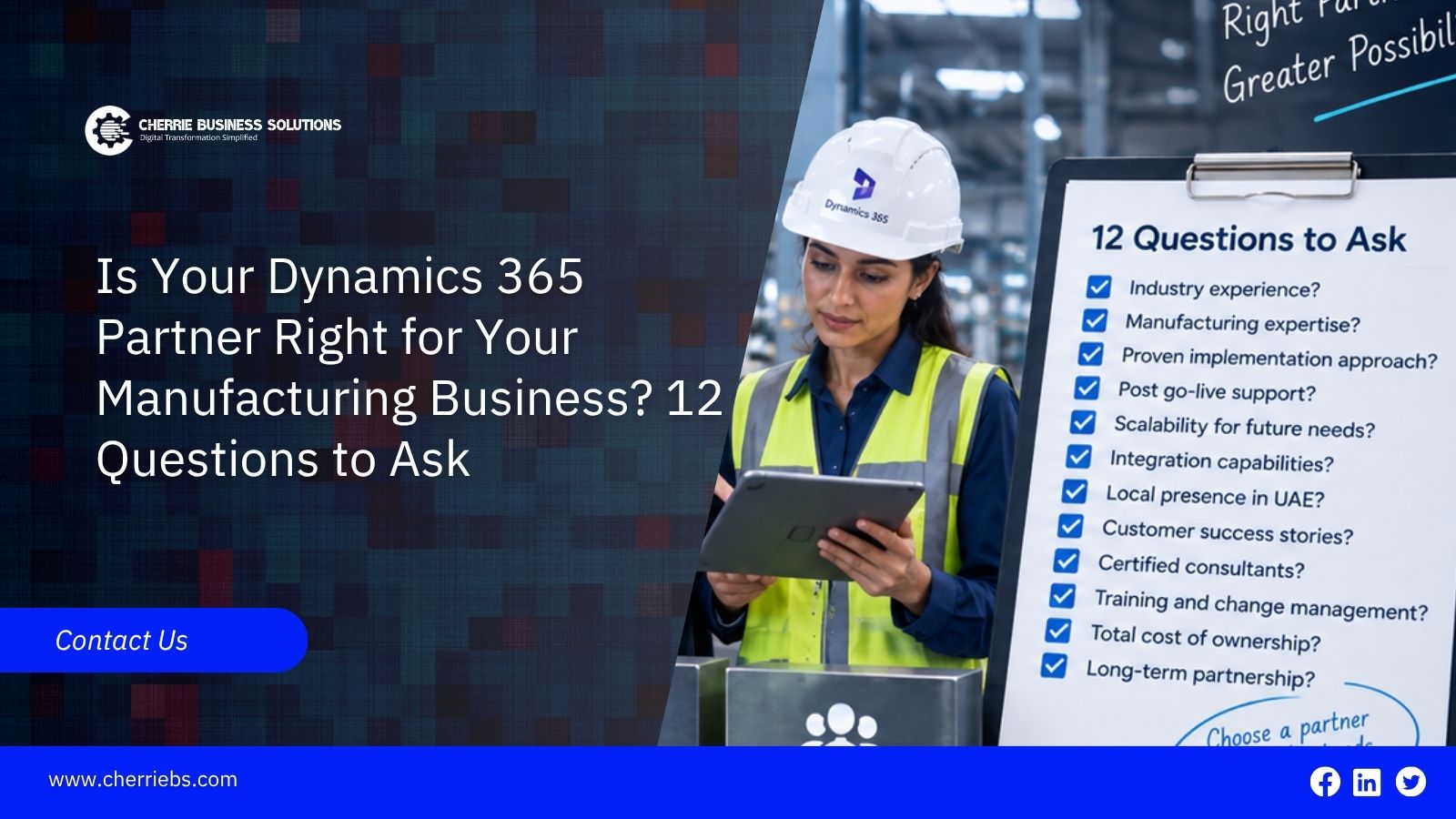
To help you protect your investment and find the right technical experts, we have put together 12 highly specific questions you must ask your potential Dynamics 365 implementation partner before signing any contracts.
Asking the right questions upfront prevents expensive mistakes down the road. Let us start with the most basic requirement of all.
1. How do you map multi-level Bills of Materials with phantom items?
Many manufacturers use a Bill of Materials. However, complex manufacturing involves layers upon layers of subassemblies. A generic software vendor might just load a flat list of parts. You need to ask how your Dynamics 365 manufacturing system implementation partner handles phantom items.
A phantom item is a grouping of components used within a larger product structure rather than a separately stocked subassembly. Your partner must know how to configure Dynamics 365 to explode these phantom assemblies correctly so your production and planning processes do not create unnecessary inventory requirements for an assembly that is not meant to be stocked separately.
Once the product structure is built, ask how they manage the actual equipment making the product.
2. What is your exact approach to machine capacity and bottlenecks?
A schedule looks great on paper until you realize you double-booked your fastest cutting machine. Ask your potential partner how they set up Master Planning and capacity constraints inside the Dynamics 365 ERP. They should be able to explain how the software handles finite capacity, resource constraints, scheduling conflicts, and available alternative resources when your primary equipment reaches maximum capacity. If they do not understand how to map finite capacity against your real-world factory hours, your digital schedule will always be an unreliable production plan.
Sometimes, those capacity constraints force you to send work outside your building.
3. How do you handle outside processing and subcontractor routing?
Almost every heavy manufacturer relies on third parties. You might cut a metal frame in your own shop, send it to a local vendor for powder coating, and then bring it back for final assembly. A generic IT consultant will struggle to track this. Ask the implementation partner exactly how Dynamics 365 handles outside processing. They must show you how the system can create or trigger the required purchasing process for the coating service, track the subcontracting step and work in progress while the material is with the vendor, and include the vendor service cost in the appropriate production costing.
Tracking parts outside the building is tough, but handling sudden design changes internally is just as tricky.
4. How do you configure Engineering Change Orders mid-production?
Engineers frequently update product designs. But what happens when an engineer changes a drawing while the factory floor is already building the older version? Ask your D365 implementation team about how they set up Engineering Change Management. They need to explain how the system manages product versions, change approvals, impact assessment, effective dates, and notifications for affected production orders, as well as how changes to BOMs and routes are handled when production is already planned or underway.
Getting those updated drawings to the assembly line brings up a massive operational question.
5. How will you configure shop floor screens for workers?
Factory workers are completely different from office workers. They are dealing with noise, grease, and heavy safety equipment. If a software partner designs a shop floor execution screen that requires workers to type long paragraphs on a tiny keyboard, workers may find it difficult to use. Ask the vendor how they configure or customize the production floor interface. They should focus on large buttons for easy accessibility, fast barcode scanning, and simple workflows that a worker can operate while wearing heavy safety gloves.
Even with the best screens, unexpected things happen on the floor that the system must handle.
6. What happens in the software if a machine breaks down mid-run?
Equipment fails unexpectedly. When a machine breaks down halfway through a job, the physical reality of the plant changes instantly. Ask your ERP implementation partner how the software handles unplanned downtime. They need to show you how a floor supervisor can record the machine failure inside the ERP, assess the effect on scheduling, and move or reschedule the remaining production work to an alternative resource where appropriate without losing production and costing traceability.
Speaking of costing, equipment failures often lead to ruined materials that must be accounted for.
7. How do you track and cost co-products, by-products, and scrap?
Manufacturing can be a complex process. Cutting sheet metal creates scrap, while chemical processing can produce by-products. A poorly configured ERP setup may not properly account for this waste, which can lead to inaccurate production costs and profit margins.
Ask the Dynamics 365 partner how they will configure the system to track unavoidable scrap. If your manufacturing process produces a useful by-product that can be sold to another company, the partner should also explain how Dynamics 365 can model and account for the main product and secondary outputs within the appropriate manufacturing and costing process.
Keeping machines running efficiently also depends on having raw materials available exactly when they are needed.
8. How will the system automate line-side raw material staging?
Your warehouse and production teams must work in close coordination to maintain smooth and efficient operations. If a machine operator has to walk across the building to find a box of bolts, you are losing money. Ask the Microsoft Dynamics 365 partner how they configure Warehouse Management to support manufacturing. They should explain how the software can generate warehouse work for raw material picking and move materials from warehouse locations to the production input location when configured appropriately, so raw materials can be staged close to the production process when they are needed.
Once those materials are turned into finished goods, they have to pass strict inspections.
9. Can you walk me through your setup for quality control rework loops?
Failing a quality test does not always mean a product goes in the trash. Often, it just needs to be sent back two steps in the process to be fixed. Ask your potential partner how they handle rework loops. If a batch of goods fails inspection, the Dynamics 365 ERP can be configured to generate quality orders and control affected inventory through quarantine or other quality processes. The vendor must also explain how they would model the required correction or rework process and track the extra labor and machine time required to fix the problem.
To make those quality checks faster, you want the machines talking directly to the software.
10. How do you link physical IoT sensors directly to production orders?
Modern factories rely on automation to stay competitive. Relying on manual processes to count every single item produced can be inefficient. Ask the partner if they have real experience connecting Programmable Logic Controllers or IoT sensors to Microsoft Dynamics. When a cutting machine finishes processing fifty units, the physical machine should be able to send production data to the ERP through an appropriate integration so the system can update production reporting and inventory based on the configured business rules, rather than relying entirely on manual keyboard entry.
When all this data finally reaches the finance team, the numbers have to make sense.
11. What is your strategy for matching standard costs against actual floor costs?
Finance departments in manufacturing rely on standard costing to predict expenses. But the actual cost of a production run can vary due to overtime, material waste, or machine delays. Ask your implementation partner how they configure variance reporting. They must prove they know how to set up the system so your financial controller can investigate why a specific production run cost more than the original estimate and identify the relevant material, labor, machine, or other production variances.
Finally, you need to know what happens when things go wrong after the partner leaves the building.
12. How will you support critical ERP issues outside regular business hours?
Factories do not always stop working at 5 p.m. If you run a second or third shift, a software freeze at two in the morning will cost you a fortune in idle wages. Ask the implementation partner what their post-go-live support actually looks like. You need a team that provides technical support during your actual operational hours, not just during their own convenient office hours. A true manufacturing partner will have a clear strategy for handling critical plant downtime emergencies, including response times, escalation procedures, and support coverage.
Asking these specific operational questions helps distinguish generic software providers from partners with genuine manufacturing expertise.
Partnering with the Right Technical Experts
Any vendor can make a software system look impressive during a controlled sales presentation. The real test of a Dynamics 365 ERP partner comes on go-live day, when your first shift arrives, and real materials begin moving through the production floor.
If barcode scanners are difficult to use, routing instructions are incorrect, or production processes are not configured properly, even a small issue can disrupt your entire operation. For manufacturers, a poorly planned go-live can quickly lead to production delays, downtime, and unnecessary costs.
That is why the implementation team at Cherrie Business Solutions prepares your Dynamics 365 manufacturing ERP system for real-world production conditions, not just a successful demonstration. We thoroughly test your specific material requirements, quality control processes, production routes, and machine capacities before the system goes live.
By handling the critical testing behind the scenes, we help ensure that your operators can use the system confidently from day one, with minimal disruption to production.
Ready for a smoother Dynamics 365 go-live? Get in touch with the Cherrie Business Solutions team to build an ERP system that supports your production floor and keeps your operations moving.