
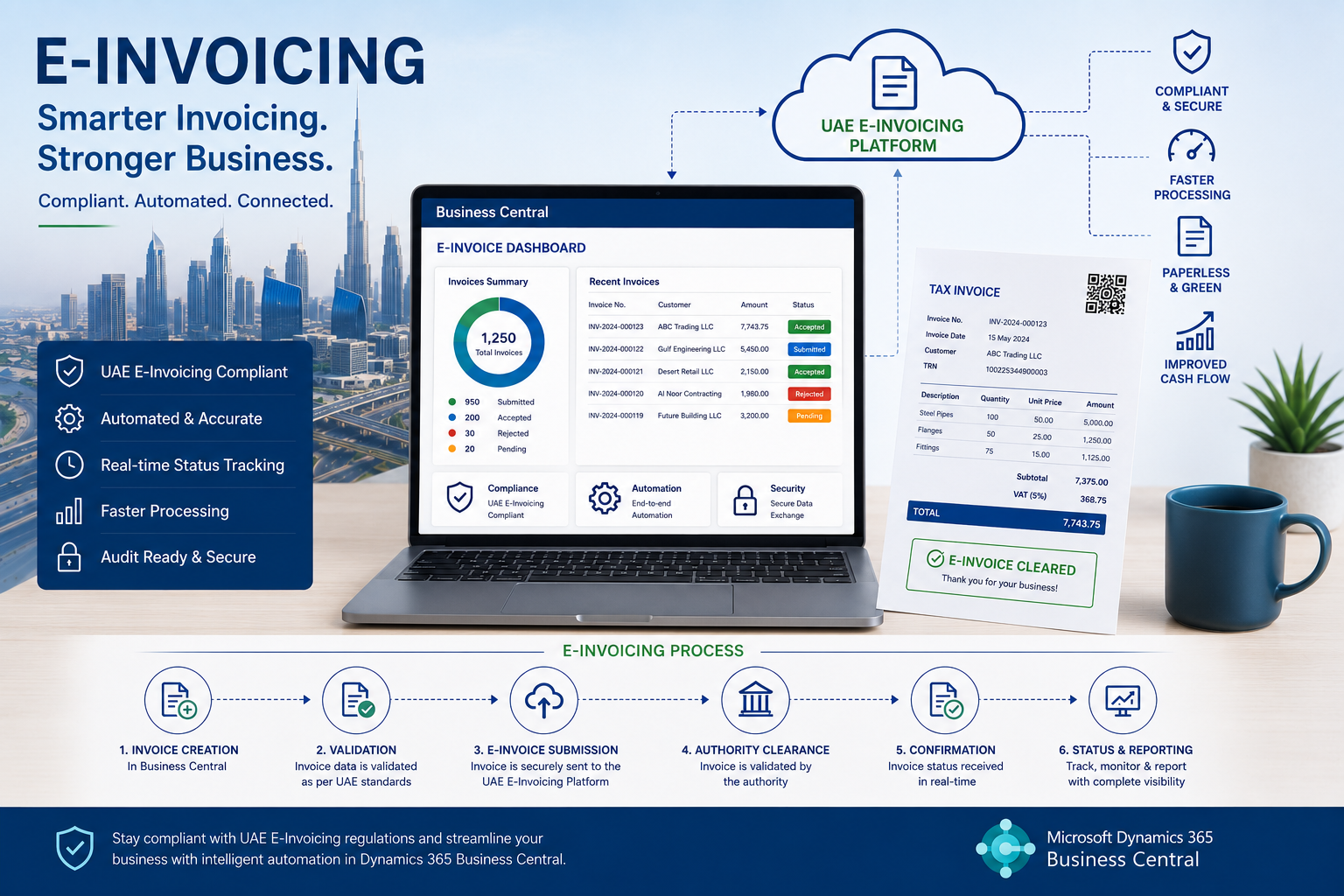
The UAE Ministry of Finance is implementing a nationwide electronic invoicing framework, with phased compliance expected to begin on January 1, 2027, starting with larger businesses that generate over AED 50 million in annual revenue. Under the new Peppol PINT AE framework, businesses must transition away from paper documents and standard PDF attachments to structured XML files. For corporate finance departments, meeting these new standards requires a complete shift from manual data entry to automated processing.
A proper UAE e-invoicing integration between Microsoft Dynamics 365 Business Central and an Accredited Service Provider turns this heavy regulatory requirement into a quiet background task. This direct connection ensures your billing stays compliant without slowing down your accounting team.
Let us explore the business and operational benefits of connecting your ERP system directly to the UAE e-invoicing network.
It Helps in Preventing Data Errors Before Reaching the Tax Authority
Under the new regulations, an electronic invoice requires specific mandatory data fields to be accepted. If a single field is missing or formatted incorrectly, the government portal will reject the entire document. Checking these details manually for every daily transaction takes too much time and creates unnecessary stress during month-end closing activities.
When you link Dynamics 365 Business Central with your invoicing software, the ERP handles the quality control for you. The system checks the document before anyone is allowed to post it. It verifies that tax registration numbers are present and that your internal unit codes translate properly to the required national standard. If an accountant forgets to add a required VAT group or leaves a mandatory reference field blank, the system stops the process and highlights the missing information on the screen.
This proactive approach clearly demonstrates why businesses in the UAE need e-invoicing for better tax reporting. It keeps your daily data clean before it ever leaves your office network, keeping your company safe from administrative fines and rejected tax filings.
Automates Invoice Transmission Through Peppol PINT AE Service Providers
The Peppol PINT AE framework requires companies to transmit their structured invoices through an Accredited Service Provider. Without a connected ERP environment, your team would need to export XML files from the accounting system and upload them to a separate provider website one by one. This manual export work completely defeats the purpose of digital billing and wastes hours of valuable staff time.
A proper integration links Business Central straight to your service provider through secure communication channels. Once your team posts a sales invoice, the ERP extracts the details and securely sends them to the provider automatically in the background. The provider then routes the invoice through the approved network while supporting compliance with government reporting requirements. Employees do not have to click extra buttons, download temporary files, or log into external websites. If your finance team is currently looking for a complete business guide to UAE e-invoicing, you will quickly see that establishing this direct software connection is a major priority.
Improves Visibility Over UAE E-Invoicing Delivery Statuses
Sending an invoice is just the first step in the collections process. Your accounts receivable team also needs to know if the client successfully received the document. In disconnected software setups, staff members have to monitor third-party dashboards constantly just to check if an invoice failed network validation or reached the buyer. This creates a disconnect between your accounting records and the actual status of the bill.
Integration fetches all network responses directly back into your Microsoft workspace. When the provider successfully delivers the document, the status of the posted invoice updates inside Business Central automatically. Your finance team can view visual indicators on their daily dashboard showing exactly which invoices went through. If a buyer rejects the bill due to a pricing disagreement, the rejection reason syncs straight back to your ledger. Your finance staff can review the issue and issue a correction without ever leaving the software they use every day.
How Microsoft Dynamics 365 Business Central Simplifies Vendor Invoice Processing
Most conversations around the January 1, 2027, mandate focus on sending bills to clients, but the new rules also change how you receive bills from your suppliers. Handling incoming vendor invoices is usually a very slow and labor-intensive process. Staff members spend hours reading PDF attachments, verifying line items, and typing the costs into the purchasing system.
Because the new national framework relies on standardized XML files, Dynamics 365 Business Central can receive inbound invoices via your provider network. The ERP reads the structured data instead of relying on a human to read a scanned image. The system uses the vendor tax number to identify the supplier instantly. It then attempts to match the incoming bill against your open purchase orders and warehouse receipts automatically. If the item quantities and prices align perfectly, the system automatically drafts the purchase invoice once the required approvals are completed. This automation significantly reduces accounts payable processing time and minimizes the risk of duplicate payments.
Simplifies E-Invoicing Credit Notes and Adjustments
When a customer returns a product or a billing error happens, the finance team issues a credit note to balance the account. Under the new UAE guidelines, a credit note follows the exact same strict formatting and reporting rules as a regular sales invoice. You can no longer just email a simple PDF credit memo to fix a billing mistake.
Integrating this adjustment process inside Business Central simplifies the compliance rules significantly. When an accountant creates a sales credit memo and applies it to the original invoice, the system automatically fetches the original transaction reference numbers into the new document. The software automatically packages this linked information into the required XML format.
This ensures the Federal Tax Authority can clearly identify the relationship between the original invoice and the subsequent adjustment, keeping your quarterly VAT filings highly accurate and easy to audit.
Supports Better Data Governance for UAE E-Invoicing Compliance
A highly helpful side effect of this technical upgrade is better internal data governance across your entire company. Many businesses operate with disorganized customer and vendor records. Sometimes delivery addresses are incomplete, contact details are outdated, or legal company names do not match official trade licenses. The old paper system made it very easy to ignore these flaws.
The new national framework requires near-perfect data mapping to function properly. Setting up your Business Central integration forces your business to audit and correct every customer and vendor profile in the system. By verifying your VAT posting setups and updating old contact details before the go-live date, your entire database becomes highly reliable. This clean environment benefits your whole organization. Your sales team gains more accurate territory reporting, while your logistics team can plan delivery routes without worrying about incorrect addresses.
Speeds Up the Entire Payment Cycle
Beyond regional tax compliance, automated billing directly benefits your corporate cash flow. Traditional billing relies on emails that often land in spam folders, get delayed by manual routing, or are kept unread in crowded inboxes. An unread invoice actively delays your payment cycle and holds back your working capital.
When Business Central sends a validated electronic document, it travels through the secure Peppol network and lands directly inside the buyer's accounting software. There are no lost email attachments or manual mailroom sorting delays. Because the buyer receives a pre-validated, mathematically correct invoice right into their own system, their accounts payable team can process the internal approval much faster. Removing these administrative delays helps growing businesses collect their money more quickly, improving overall financial stability and corporate liquidity.
Conclusion
Adapting to the new government billing standards is a major step toward achieving e-invoicing compliance in the UAE, but it also brings real value to your daily operations. Instead of treating this mandate as a heavy burden, connecting to Dynamics 365 Business Central allows your team to automate the hardest parts of accounting. You eliminate the risk of typing errors, speed up the time it takes to collect customer payments, and ensure every document matches the strict tax rules before it ever leaves your office. To make this happen safely, you need a technical partner who understands local business. Cherrie Business Solutions is here to guide you. As an experienced E-invoicing company in the UAE, we configure the software to fit your specific daily workflow.
Reach out to our team today to prepare your Business Central environment for UAE e-invoicing compliance and ensure a smooth transition before the mandatory rollout begins.