
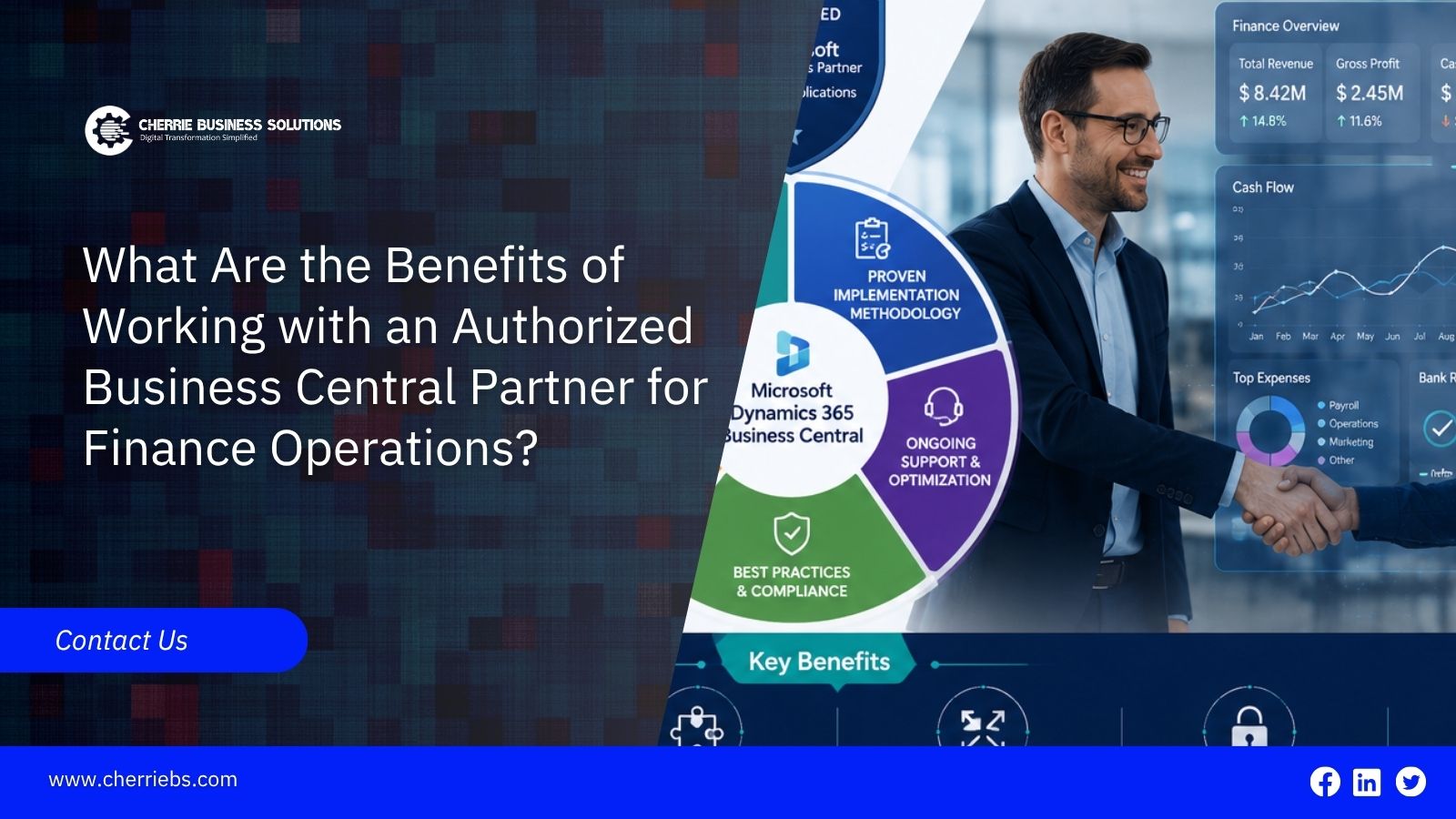
Implementing Microsoft Dynamics 365 Business Central is a major milestone for growing companies looking to modernize their accounting processes. However, financial software is only as good as its configuration. Standard IT teams or internal accounting staff often struggle to map complex tax rules, custom ledger structures, and automated bank feeds correctly. In this situation, partnering with an authorized Business Central partner transforms an intimidating software deployment into a structured business upgrade. Expert partners bring the technical framework and accounting experience required to align the system directly with your financial workflows.
Throughout this article, we’ll explore the real-world benefits of partnering with an authorized Business Central partner for your finance and operations.
1. They Assist in Simplifying Your Chart of Accounts with Financial Dimensions
Many growing companies make a common mistake when moving to a new ERP system. They simply copy and paste their old chart of accounts into the new software. In older legacy ERP systems, tracking expenses across different departments required creating thousands of unique ledger codes. If a company wants to track marketing expenses across 5 different office locations, the old system forces them to create five separate ledger lines. This bloated structure slows down data entry and makes reporting incredibly confusing.
A specialized Business Central partner can prevent this administrative difficulty by leveraging a powerful feature called Financial Dimensions. Instead of expanding the master chart of accounts, the partner sets up global and shortcut dimensions as simple metadata tags. They can reduce the need for hundreds or thousands of redundant ledger accounts by using dimensions for departments, locations, and other reporting requirements.
When an accounts payable clerk posts a vendor invoice for office supplies, they select one single main expense account. Then, they simply tag the specific department and location from a drop-down menu. This architectural guidance from a partner keeps financial reporting clean and allows your finance managers to run detailed cost center reports without sorting through endless lines of redundant code.
Once your core ledger is organized properly, the implementation partner focuses on streamlining complex corporate structures.
2. Reducing Month-End Closing Times by Automating Intercompany Consolidations
Managing multiple subsidiary companies introduces severe operational friction when accounting systems are not configured correctly. In many organizations, accountants spend the first week of every month exporting data from different databases into spreadsheets just to consolidate financial statements. Dealing with intercompany loans, shared services, and cross-company billing manually can sometimes lead to human errors.
In this scenario, an authorized implementation partner understands how to establish a robust intercompany setup within Microsoft Dynamics 365. They configure partner company relationships so that a transaction in one subsidiary automatically creates the corresponding balancing entries in another.
If the parent company pays a software subscription fee on behalf of a subsidiary in Dubai, the system handles the cross-charges instantly. The partner sets up the automated elimination entries required for proper group reporting. This level of expert configuration eliminates duplicate data entry across different company databases and provides business owners with a clear, unified view of group-wide performance.
Consolidating multiple companies saves days of work, but accelerating your daily cash tracking is equally important for financial health.
3. Making Bank Reconciliation Simpler with Automated Data Flows
Month-end bank reconciliation is notoriously time-consuming when done line by line. Without proper configuration, finance teams print out bank statements and use highlighters to match incoming payments against open sales invoices. In this case, an experienced Dynamics 365 partner configures Business Central to handle this matching process automatically by connecting the ERP directly with your bank transaction data.
The consultant imports and maps your local electronic bank statement formats, such as standard CSV feeds or specialized bank files. The true value of the partner comes from building the specific tolerance rules and matching logic. They configure the ERP software to evaluate transaction amounts, reference numbers, and customer names to clear matching items instantly.
If a customer pays an invoice but is short by a few dirhams due to bank transfer fees, the partner can configure rules to auto-write off minor discrepancies. Your accounting staff only needs to review the few unmapped exceptions, drastically cutting down the time required to close the books each month.
4. Supporting Regional Tax Compliance and UAE E-Invoicing Regulations
Financial compliance is non-negotiable. Making mistakes on regulatory filings leads to heavy financial penalties and stressful regulatory audits. Standard out-of-the-box software configurations may not fully address local tax requirements. Here, a specialized regional partner ensures your ERP system strictly adheres to the latest local tax laws, building the current Value Added Tax and Corporate Tax calculations directly into the background of your purchasing and sales workflows.
For businesses operating in the UAE, compliance now goes far beyond standard VAT returns. The Ministry of Finance is rolling out a mandatory e-invoicing framework that fundamentally changes how companies bill their clients. Starting January 1, 2027, companies with annual revenues of AED 50 million or more must adopt the Decentralized Continuous Transaction Control and Exchange (DCTCE) framework, commonly known as the Peppol 5-corner model.
An expert implementation partner configures your system to generate the highly specific structured PINT AE XML files required by the government. They ensure your software integrates perfectly with an Accredited Service Provider (ASP), which you must formally appoint by the strict deadline of October 30, 2026. By building these Peppol 5-corner model workflows into your daily operations now, the partner protects your business from the AED 5,000 monthly non-compliance penalties and ensures your billing cycles continue without disruption when the new UAE e-invoicing mandate takes effect.
After all these workflows and compliance rules are built, the final and most critical step is moving your historical financial data into the new software safely.
5. Reducing Risks During Financial Data Migration
Moving years of open invoices, vendor ledgers, and customer balances into a new ERP software is the riskiest phase of any software transition. A failed data migration halts business operations immediately. Internal IT teams often struggle here because they lack a proven methodology to clean and format legacy data.
Experienced ERP implementation partners utilize structured data packages to extract and transform your historical records. They provide your team with clear templates to ensure old, irrelevant data is left behind. Most importantly, they do not just import the data and hope it works. They run rigorous test migrations in secure sandbox environments.
The partner guides your finance team through a User Acceptance Testing phase. During this phase, your accountants log in and verify that migrated balances and financial records reconcile with the source system before the final go-live. This meticulous methodology helps ensure your billing, payroll, and collection processes continue smoothly after go-live.
Ultimately, attempting to configure an enterprise financial system without professional help is a risk that growing companies cannot afford to take. By partnering with an authorized consultant, you ensure your software investment translates into a faster, more accurate, and fully compliant finance department.
Final Notes: Choosing the Right Implementation Partner
Every successful business knows that upgrading your financial system is a major step, and configuring it correctly requires careful planning to keep your operations running smoothly. This is the reason why expert businesses operating across the UAE and GCC prefer working with Cherrie Business Solutions for a precise, well-managed Dynamics 365 implementation. As an authorized partner, we guide your team through the entire process, ensuring your software investment helps create a faster, more accurate, and compliant finance operation.
What Does Cherrie Business Solutions Actually Deliver for Clients?
We bridge the gap between technical software features and daily financial operations. When you choose to partner with our team, we focus entirely on delivering tangible, operational improvements for your leadership and accounting teams.
Here’s how our well-configured Dynamics 365 ERP provides value for our clients.
-
Better Business Visibility: Management and owners can see all company data in one dashboard.
-
Faster Decision-making: Issues will be visible in real time rather than weeks or months later.
-
Centralized data: No more scattered, department-siloed information.
-
Timely Financial Information: Mid-level and senior managers get reliable, timely data.
Our Key Client Example: A Recent Financial Go-Live
To show how this works in practice, consider a recent project we completed for a growing organization.
-
The Challenge: The client managed five different subsidiary companies. Previously, their accounting staff spent 5 to 6 days manually consolidating financials in Excel every single month.
-
The Solution: We implemented Business Central to centralize the financial operations of all five companies and streamline the consolidation process.
-
Additional Benefit: Data mismatches between the different entities are now completely traceable and resolvable immediately inside the system.
Our Core Promise to Every Client
-
Consistent Delivery: We provide reliable, expert support throughout the entire implementation lifecycle.
-
Affordable Pricing: We deliver high-quality consulting services that fit your corporate budget.
-
Meeting Expectations: We ensure your specific business requirements are met at every single stage of the project.
We view every implementation as a shared journey. By combining our software skills with your specific business workflow, we ensure a smooth and successful transition. If you are ready to modernize your finance operations with a partner who delivers proven results, our team is ready to help you build a smarter financial future.