
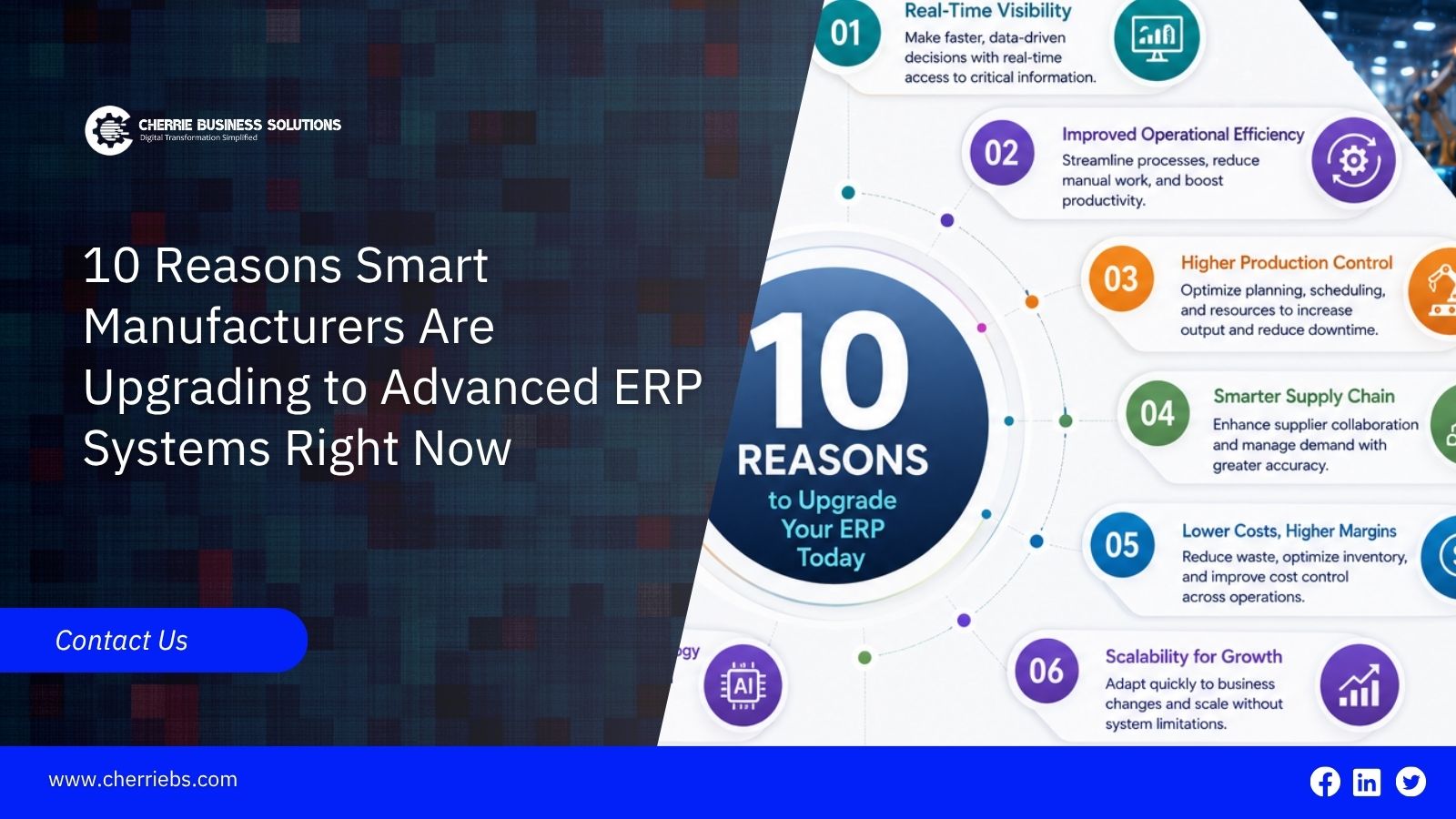
Manufacturing plants operate on tight margins where small delays cost real money. Modern production requires an efficient ERP solution to handle supply chain shifts, rising material costs, and strict customer deadlines. This is why smart manufacturers are upgrading to an advanced ERP system that provides plant managers with the clear, connected data they need to keep assembly lines running and protect company profits.
Throughout this blog, let us explore the top 10 reasons why leading manufacturers are making this change today.
What Defines an Advanced Manufacturing ERP?
Before we look at the 10 reasons, let’s understand how an advanced ERP works compared to older ERP software. Older or disconnected systems can leave departments working with separate data sources, spreadsheets, or delayed updates. Your inventory, production scheduling, and accounting programs may not share information or sync automatically. When data is delayed, your staff may be forced to retype the same data into different programs and guess what is actually happening during a busy shift.
An advanced ERP helps fix this by bringing core business data together in a connected system. Since many large manufacturers use Microsoft Dynamics 365 ERP, we will use it as our main example. This platform can connect incoming sales orders with your factory floor and warehouse.
When a worker moves a pallet of materials or a machine finishes a job, inventory and financial records can be updated in near real time, depending on the system configuration. This shift from slow, manual data entry to live tracking is one reason why plant managers are making the switch today.
1. Preventing Inventory Shortages
Nothing stops an assembly line faster than missing parts. Your ERP might say you have fifty steel pipes available, but the physical warehouse rack is empty. Older or disconnected systems can cause this frustrating disconnect because stock changes may not be reflected immediately. Modern ERP platforms like Dynamics 365 can help track materials in real time.
Here’s how manufacturing firms can achieve efficiency with Microsoft Dynamics 365
-
Warehouse staff can use standard barcode scanners right on the loading dock to log items into the ERP system immediately.
-
Moving a box from storage to the assembly line can update the central database in real time.
-
Production planners can schedule their shifts using more accurate inventory numbers. With this, they can largely avoid unexpected shutdowns caused by missing parts.
2. Preventing Sudden Machine Breakdowns Before They Happen
When a essential piece of factory equipment breaks, the financial loss adds up by the minute. Traditional maintenance involves checking a machine every few months based on a static calendar. But machines do not follow calendars. A motor can wear out weeks before its scheduled inspection.
In fact, research by Deloitte shows that unplanned downtime costs industrial manufacturers an estimated $50 billion annually. However, upgrading to a system with predictive maintenance capabilities can decrease equipment downtime by up to 50% and significantly reduce overall maintenance costs.
To reduce this risk and gain better visibility into machine health, modern manufacturing systems can monitor machine activity and abnormalities by connecting with IoT sensors placed on specific machines across the factory.
-
These sensors track everyday indicators like heat levels and operating vibrations.
-
If a conveyor belt starts vibrating strangely, the software can flag it as an early warning.
-
Your maintenance crew can get a digital alert to inspect the part during a scheduled break, helping fix the issue long before the machine breaks down.
3. Controlling Volatile Raw Material Costs
The cost of raw goods changes almost daily. If your company builds complex products with dozens of individual parts, updating those fluctuating costs manually is nearly impossible. A sudden spike in aluminum prices can wipe out your profit margin if you do not adjust your customer quotes fast enough. Upgrading to Microsoft Dynamics 365 can help automate these complicated financial calculations.
Here are the benefits manufacturing firms can gain by implementing modern ERP software.
-
Your supplier pricing and material costs can be linked to the relevant bills of materials.
-
When a vendor increases the price of a specific material, the software can recalculate the final production cost of any finished item using that component.
-
The sales department can see the new baseline cost, helping them quote profitable prices to clients.
4. Resolving Shop Floor Scheduling Conflicts
Figuring out who is working on which machine is a difficult daily puzzle. When planners track these with whiteboards or static spreadsheets, a single urgent customer order throws the entire day into chaos. It becomes incredibly easy to accidentally assign two different jobs to the same workstation. However, implementing advanced ERP tools can help avoid the confusion by providing an interactive visual planning board.
-
The system can evaluate machine availability, the required tools for the job, and which workers have the correct training based on the data provided.
-
Supervisors can drag and drop a high-priority order into the schedule, and the software can automatically shift the remaining jobs to fit based on the rules that management has set.
-
As a result, everyone can see the real-time workflow and what’s happening on the same live dashboard, so the production team always knows what to build next.
5. Predicting Supplier Shipping Delays Early
Your production timeline depends entirely on suppliers delivering materials on time. Legacy software assumes every vendor will deliver on the promised date. Anyone working in manufacturing knows late deliveries happen constantly, leaving your workers standing around waiting for parts. Modern enterprise systems can use historical supplier data, planning tools, and AI capabilities to improve delivery-date estimates. With this, they can help predict more reliable expected vendor delivery dates.
-
The software keeps a permanent record of how often a specific supplier delivers late or sends damaged goods.
-
If a vendor shows a pattern of delayed shipments, the system can use this information to improve future planning schedules.
-
Your procurement team can get a notification to place purchase orders a few days earlier, buying enough time to keep the assembly line fed.
6. Finding Product Defects Early on the Line
Finding a broken item right as it goes into a shipping box is a terrible feeling because you have already spent money paying someone to build it. Advanced ERP systems can support quality control directly in the building process rather than waiting until the end.
-
Workers interact with the ERP interface at their workstations that ask for specific measurements or visual checks before a part moves forward.
-
If a measurement is wrong, the system can instantly place that specific item on a quality hold.
-
The wrong or defective part is pulled off the line immediately, which prevents your team from wasting more labor and parts on something that will ultimately be thrown away.
-
This whole process can be supported by quality-management functionality, shop-floor data collection, and, where needed, IoT sensors connected to the ERP system.
7. Connecting Multiple Factory Locations Under One System
When a successful manufacturing business opens a second facility, communication often breaks down. If the new plant uses a different software program than the main headquarters, executives cannot get a clear picture of what the company actually owns or how much it can produce. Cloud-based platforms can put every location under one shared digital system and provide complete data in a single interface.
Here’s how this approach benefits manufacturing firms:
-
A manager at the head office can see the inventory levels of a warehouse located at another company location.
-
If one factory falls behind schedule due to a power outage, managers can identify available capacity at another facility and adjust production plans accordingly.
-
Staff can easily coordinate moving excess materials from a slow plant to a busy one.
8. Meeting Strict Compliance Rules Without Extra Paperwork
Businesses that make food products, medical tools, or automotive parts must follow strict tracing rules. If a supplier tells you they sent a defective batch of packaging material, you must know exactly which finished products contain that material. Searching through paper logbooks and Excel sheet to find this information takes days and causes incredible stress. Advanced ERP platforms can automate this tracking from the moment a truck arrives.
-
Parts can be tracked using lot, batch, or serial numbers based on the company’s tracking requirements.
-
If a recall happens, a manager can generate a trace report with an advanced ERP in a few minutes.
-
You can locate the affected products immediately, whether they are still in your warehouse or already sitting at a customer site.
9. Linking Customer Sales Orders Directly to Production
In older business setups, the sales team and the factory floor are completely disconnected. When a salesperson closes a big deal, they email the paperwork to the plant manager and wait days for someone to manually check the warehouse for parts.
Let us look at how advanced ERP like Microsoft Dynamics 365 can help fix this using a real-world scenario. Imagine a sales representative just closed an order for custom commercial water pumps for a client in Dubai. Instead of sending an email and waiting in the dark, the ERP system can connect the sale directly to the factory floor.
-
The moment the order is confirmed in the system, it can check the warehouse for the necessary components.
-
If any materials are missing to build those pumps, the software can identify the shortage and, depending on the configured planning rules, generate purchase or replenishment suggestions for the procurement team to review.
-
The factory planners can see the new demand immediately, allowing them to adjust their daily schedules without waiting for a phone call.
10. Tracking True Job Profitability in Real Time
Many manufacturing leaders review their month-end financial statements only to discover that their profit margins fall short of initial projections. The underlying cause is often untracked operational expenses. Unplanned labor overtime, emergency machine maintenance, and scrapped materials silently take away the anticipated profit of a production run. Upgrading to smarter ERPs provides your finance team with accurate, real-time visibility into true manufacturing costs.
-
The ERP tracks actual labor hours and machine operating time as the work happens on the floor.
-
Accountants can analyze a project mid-production to see if it is exceeding its allocated budget.
-
Management can use this factual data to adjust future pricing quotes, ensuring the company stops accepting orders that result in a financial loss.
Final Notes: Modernizing Your Operations with Cherrie Business Solutions
The 10 reasons we covered all point to one clear reality. Running a profitable manufacturing plant today requires connected data. But simply buying Microsoft Dynamics 365 will not automatically organize your warehouse or speed up your assembly line on its own. The system must be tailored with an authorized implementation partner to align with your workflow.
This is where Cherrie Business Solutions steps in. As an authorized Dynamics 365 partner, we deliver real business knowledge, industry insights, and 12+ years of practical experience across the UAE and GCC to configure and personalize manufacturing ERP systems.
If you are ready to expand your production capabilities, let us connect and design a system that supports your future growth.